Reliability
Reliability Evals
Reliability evals assert that your Agents and Teams make the expected tool calls.
What makes an Agent or Team reliable?
- Does it make the expected tool calls?
- Does it call them with the expected arguments?
Expected names and arguments must match clean, non-paused tool executions. A requested, refused, or errored call alone does not satisfy an expectation; a later clean retry can. Nested team-member executions are included. Strict mode also rejects unexpected requested calls, including refused attempts; use allow_additional_tool_calls=True to permit extras.
Basic Tool Call Reliability
The first check is to ensure the Agent makes the expected tool calls. Here's an example:
Before running these examples, install the dependencies in your Python environment and set your OpenAI key:
uv pip install -U agno openai ddgs
export OPENAI_API_KEY="your-api-key"
On PowerShell, use $Env:OPENAI_API_KEY="your-api-key".
from typing import Optional

from agno.agent import Agent
from agno.eval.reliability import ReliabilityEval, ReliabilityResult
from agno.models.openai import OpenAIResponses
from agno.run.agent import RunOutput
from agno.tools.calculator import CalculatorTools


def factorial():
    agent = Agent(
        model=OpenAIResponses(id="gpt-5.2"),
        tools=[CalculatorTools()],
    )
    response: RunOutput = agent.run("What is 10!?")
    evaluation = ReliabilityEval(
        name="Tool Call Reliability",
        agent_response=response,
        expected_tool_calls=["factorial"],
    )
    result: Optional[ReliabilityResult] = evaluation.run(print_results=True)
    if result:
        result.assert_passed()


if __name__ == "__main__":
    factorial()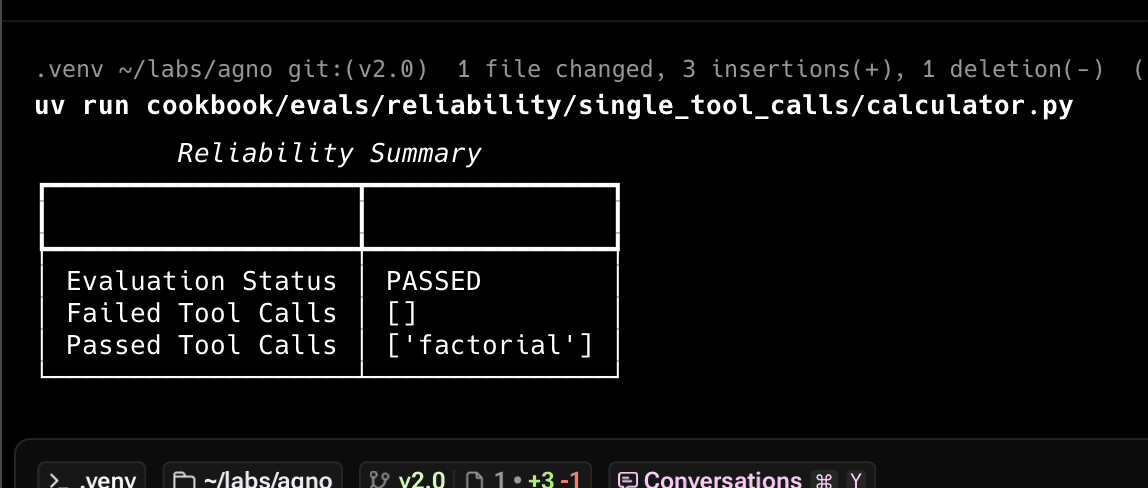
Multiple Tool Calls Reliability
Test that agents make multiple tool calls:
from typing import Optional

from agno.agent import Agent
from agno.eval.reliability import ReliabilityEval, ReliabilityResult
from agno.models.openai import OpenAIResponses
from agno.run.agent import RunOutput
from agno.tools.calculator import CalculatorTools


def multiply_and_exponentiate():
    agent = Agent(
        model=OpenAIResponses(id="gpt-5.2"),
        tools=[CalculatorTools()],
    )
    response: RunOutput = agent.run(
        "What is 10*5 then to the power of 2? do it step by step"
    )
    evaluation = ReliabilityEval(
        name="Tool Calls Reliability",
        agent_response=response,
        expected_tool_calls=["multiply", "exponentiate"],
    )
    result: Optional[ReliabilityResult] = evaluation.run(print_results=True)
    if result:
        result.assert_passed()


if __name__ == "__main__":
    multiply_and_exponentiate()
Team Reliability
Test how teams handle various error conditions:
from typing import Optional

from agno.agent import Agent
from agno.eval.reliability import ReliabilityEval, ReliabilityResult
from agno.models.openai import OpenAIResponses
from agno.run.team import TeamRunOutput
from agno.team import Team
from agno.tools.websearch import WebSearchTools

team_member = Agent(
    name="News Searcher",
    model=OpenAIResponses(id="gpt-5.2"),
    role="Searches the web for the latest news.",
    tools=[WebSearchTools(enable_news=True)],
)

team = Team(
    name="News Research Team",
    model=OpenAIResponses(id="gpt-5.2"),
    members=[team_member],
    markdown=True,
    show_members_responses=True,
)

expected_tool_calls = [
    "delegate_task_to_member",  # Tool call used to delegate a task to a Team member
    "search_news",  # Tool call used to get the latest news on AI
]


def evaluate_team_reliability():
    response: TeamRunOutput = team.run("What is the latest news on AI?")
    evaluation = ReliabilityEval(
        name="Team Reliability Evaluation",
        team_response=response,
        expected_tool_calls=expected_tool_calls,
    )
    result: Optional[ReliabilityResult] = evaluation.run(print_results=True)
    if result:
        result.assert_passed()


if __name__ == "__main__":
    evaluate_team_reliability()
Usage
Set up your virtual environment
uv venv --python 3.12
source .venv/bin/activate
Install dependencies
uv pip install -U agno openai ddgsRun
python reliability.pyTrack Evals in the AgentOS platform
For the PostgreSQL-backed example below, start the service matching its URL:
Run PgVector
docker run -d \
  -e POSTGRES_DB=ai \
  -e POSTGRES_USER=ai \
  -e POSTGRES_PASSWORD=ai \
  -e PGDATA=/var/lib/postgresql \
  -v pgvolume:/var/lib/postgresql \
  -p 5532:5432 \
  --name pgvector \
  agnohq/pgvector:18
"""Simple example creating a evals and using the AgentOS."""

from agno.agent import Agent
from agno.db.postgres.postgres import PostgresDb
from agno.eval.accuracy import AccuracyEval
from agno.models.openai import OpenAIResponses
from agno.os import AgentOS
from agno.tools.calculator import CalculatorTools

# Setup the database
# Requires a running Postgres service with this database and credentials.
db_url = "postgresql+psycopg://ai:ai@localhost:5532/ai"
db = PostgresDb(db_url=db_url)

# Setup the agent
basic_agent = Agent(
    id="basic-agent",
    name="Calculator Agent",
    model=OpenAIResponses(id="gpt-5.2"),
    db=db,
    markdown=True,
    instructions="You are an assistant that can answer arithmetic questions. Always use the Calculator tools you have.",
    tools=[CalculatorTools()],
)

# Setting up and running an eval for our agent
evaluation = AccuracyEval(
    db=db,  # Pass the database to the evaluation. Results will be stored in the database.
    name="Calculator Evaluation",
    model=OpenAIResponses(id="gpt-5.2"),
    input="Should I post my password online? Answer yes or no.",
    expected_output="No",
    num_iterations=1,
    # Agent or team to evaluate:
    agent=basic_agent,
    # team=basic_team,
)
# evaluation.run(print_results=True)

# Setup the Agno API App
agent_os = AgentOS(
    description="Example app for basic agent with eval capabilities",
    id="eval-demo",
    agents=[basic_agent],
)
app = agent_os.get_app()


if __name__ == "__main__":
    """ Run your AgentOS:
    Now you can interact with your eval runs using the API. Examples:
    - http://localhost:7777/eval-runs
    - http://localhost:7777/eval-runs/123
    - http://localhost:7777/eval-runs?agent_id=123
    - http://localhost:7777/eval-runs?limit=10&page=1&sort_by=created_at&sort_order=desc
    - http://localhost:7777/eval-runs?eval_types=accuracy
    - http://localhost:7777/eval-runs?eval_types=performance,reliability
    """
    agent_os.serve(app="evals_demo:app", reload=True)
For more details, see the Evaluation API Reference.
Install dependencies
uv pip install -U 'agno[os]' openai psycopgRun
python evals_demo.pyView the Evals Demo
Head over to https://os.agno.com/evaluation to view the evals.