Agent As Judge
Agent as Judge Evals
Agent as Judge evals measure custom quality criteria for your Agents and Teams using LLM-as-a-judge methodology.
Agent as Judge evaluations let you define custom quality criteria and use an LLM to score your Agent's responses. You provide evaluation criteria (like "professional tone", "factual accuracy", or "user-friendliness"), and an evaluator model assesses how well the Agent's output meets those standards.
Custom evaluators own their instructions: criteria and additional_guidelines are not automatically injected when evaluator_agent is supplied. Include the complete rubric in that agent’s prompt.
Basic Example
Here, AgentAsJudgeEval takes the Agent's input and output and scores the response against the criteria you set.
Before running these examples, install the dependencies in your Python environment and set your OpenAI key:
uv pip install -U agno openai sqlalchemy
export OPENAI_API_KEY="your-api-key"
On PowerShell, use $Env:OPENAI_API_KEY="your-api-key".
from agno.agent import Agent
from agno.db.sqlite import SqliteDb
from agno.eval.agent_as_judge import AgentAsJudgeEval
from agno.models.openai import OpenAIResponses

# Setup database to persist eval results
db = SqliteDb(db_file="tmp/agent_as_judge_basic.db")

agent = Agent(
    model=OpenAIResponses(id="gpt-5.2"),
    instructions="You are a technical writer. Explain concepts clearly and concisely.",
    db=db,
)

response = agent.run("Explain what an API is")

evaluation = AgentAsJudgeEval(
    name="Explanation Quality",
    criteria="Explanation should be clear, beginner-friendly, and use simple language",
    scoring_strategy="numeric",  # Score 1-10
    threshold=7,  # Pass if score >= 7
    db=db,
)

result = evaluation.run(
    input="Explain what an API is",
    output=str(response.content),
    print_results=True,
)
Custom Evaluator Agent
You can use a custom agent to evaluate responses with specific instructions:
from agno.agent import Agent
from agno.eval.agent_as_judge import AgentAsJudgeEval
from agno.models.openai import OpenAIResponses

agent = Agent(
    model=OpenAIResponses(id="gpt-5.2"),
    instructions="Explain technical concepts simply.",
)

response = agent.run("Explain what an API is")

# Create a custom evaluator with specific instructions
custom_evaluator = Agent(
    model=OpenAIResponses(id="gpt-5.2"),
    description="Strict technical evaluator",
    instructions="You are a strict evaluator. Only pass exceptionally clear, technically accurate, and comprehensive explanations.",
)

evaluation = AgentAsJudgeEval(
    name="Technical Accuracy",
    criteria="Explanation must be technically accurate and comprehensive",
    evaluator_agent=custom_evaluator,
)

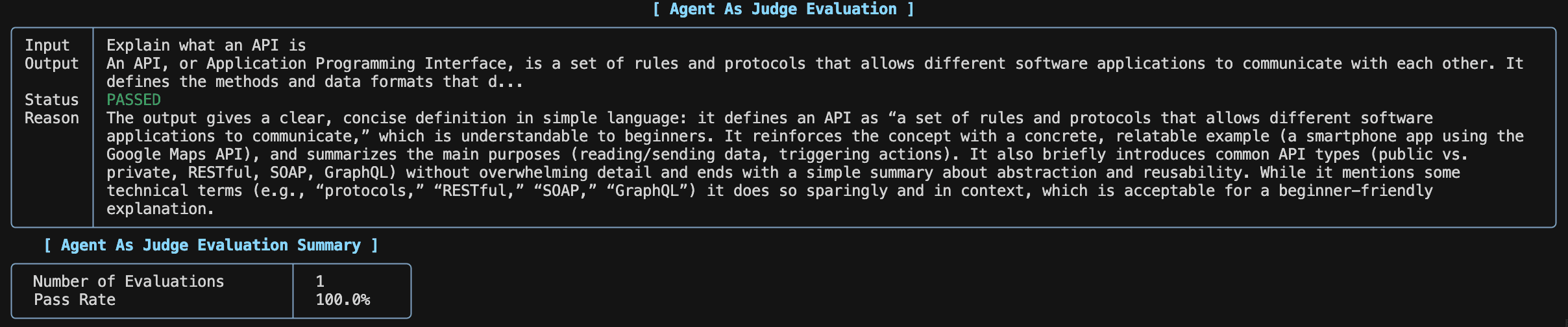
result = evaluation.run(
    input="Explain what an API is",
    output=str(response.content),
    print_results=True,
    print_summary=True,
)
Params
| Parameter | Type | Default | Description |
|---|---|---|---|
criteria | str | "" | The evaluation criteria describing what makes a good response. Always set this; an unset value produces an unconstrained judge prompt. |
scoring_strategy | Literal["numeric", "binary"] | "binary" | Scoring mode: "numeric" (1-10 scale) or "binary" (pass/fail). |
threshold | int | 7 | Minimum score to pass (only used for numeric strategy). |
on_fail | Optional[Callable] | None | Callback function triggered when evaluation fails. |
additional_guidelines | Optional[Union[str, List[str]]] | None | Extra evaluation guidelines beyond the main criteria. |
name | Optional[str] | None | Name for the evaluation. |
model | Optional[Model] | None | Model to use for judging (defaults to gpt-5-mini if not provided). |
evaluator_agent | Optional[Agent] | None | Custom agent to use as evaluator. |
print_summary | bool | False | Print summary of evaluation results. |
print_results | bool | False | Print detailed evaluation results. |
show_spinner | bool | True | Show a progress spinner while the eval runs. |
file_path_to_save_results | Optional[str] | None | File path to save evaluation results. |
debug_mode | bool | False | Enable debug mode for detailed logging. |
db | Optional[Union[BaseDb, AsyncBaseDb]] | None | Database to store evaluation results. |
telemetry | bool | True | Enable telemetry. |
Methods
run() / arun()
Run the evaluation synchronously (run()) or asynchronously (arun()).
| Parameter | Type | Default | Description |
|---|---|---|---|
input | Optional[str] | None | Input text for single evaluation. |
output | Optional[str] | None | Output text for single evaluation. |
cases | Optional[List[Dict[str, str]]] | None | List of input/output pairs for batch evaluation. |
print_summary | bool | False | Print summary of evaluation results. |
print_results | bool | False | Print detailed evaluation results. |
Provide either (input, output) for single evaluation OR cases for batch evaluation, not both.
Run in a Suite
To gate many judge checks in CI, declare a Case per input with criteria and run them as a suite. judge_mode and judge_threshold on the Case map to scoring_strategy and threshold here, with the same defaults. See Eval Suites.
Examples
Basic Agent as Judge
Basic usage with numeric scoring and failure callbacks
Agent as Judge as Post-Hook
Automatic evaluation after agent runs