> ## Documentation Index
> Fetch the complete documentation index at: https://docs.agno.com/llms.txt
> Use this file to discover all available pages before exploring further.
# Branching Workflow
> Route to different steps at runtime with Router and a selector function.
**Example use cases**: Expert routing, content type detection, multi-path processing
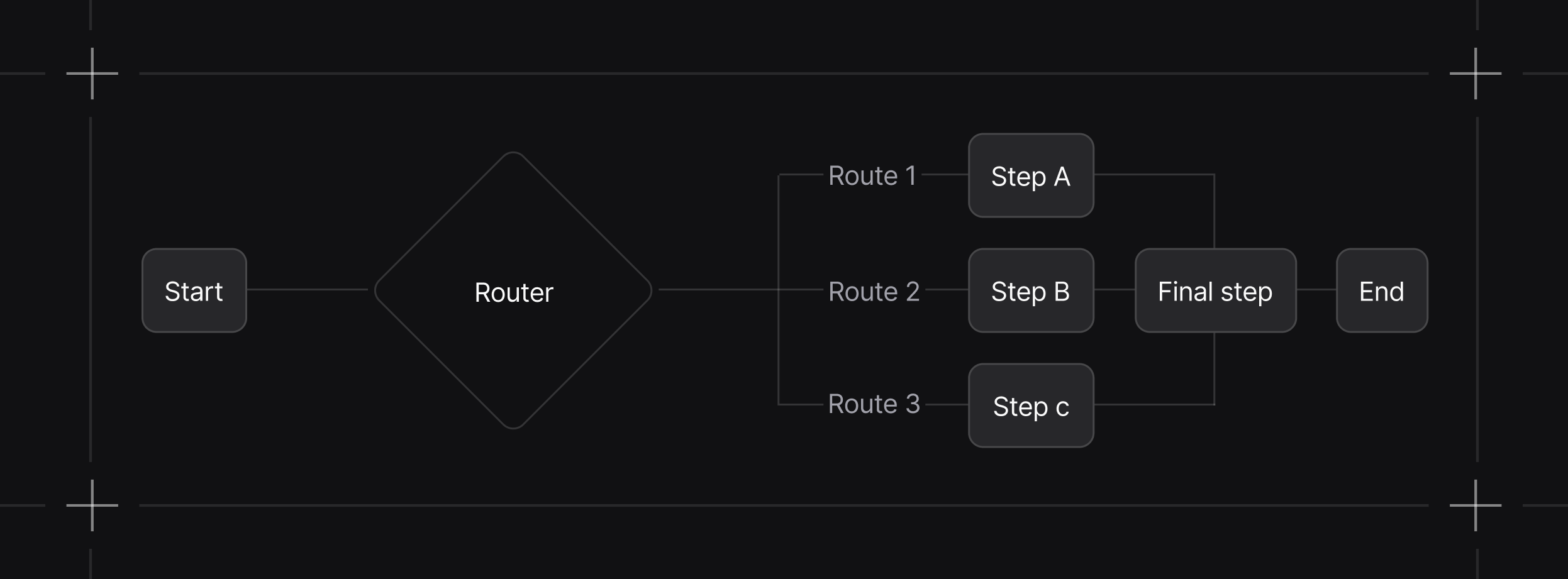
A `Router` uses a selector function to decide at runtime which of its `choices` to execute. Multiple selected choices run sequentially. A selected `Parallel`, `Loop`, or other container applies its own control flow.

 ## Selector Flexibility
The Router selector function supports multiple return types:
| Return value | Behavior |
| ------------------------------------------------------------- | ----------------------------------------------- |
| Step name as `str` | Resolve the matching named choice |
| `Step`, `Steps`, `Condition`, `Loop`, `Parallel`, or `Router` | Execute that step-like object |
| `list` of supported values | Resolve each item and execute them sequentially |
The selector can also receive `step_choices` as an optional second parameter for dynamic selection, or be a [CEL expression](/examples/workflows/cel-expressions/router/cel-ternary) string that returns a step name.
## Example: String-based Selector
The simplest approach is to return the step name as a string:
```python branching_workflow.py theme={null}
from typing import Union, List
from agno.agent import Agent
from agno.models.openai import OpenAIChat
from agno.workflow import Router, Step, StepInput, Workflow
tech_expert = Agent(
name="tech_expert",
model=OpenAIChat(id="gpt-4o-mini"),
instructions="You are a tech expert. Provide technical analysis.",
)
biz_expert = Agent(
name="biz_expert",
model=OpenAIChat(id="gpt-4o-mini"),
instructions="You are a business expert. Provide business insights.",
)
generalist = Agent(
name="generalist",
model=OpenAIChat(id="gpt-4o-mini"),
instructions="You are a generalist. Provide general information.",
)
tech_step = Step(name="Tech Research", agent=tech_expert)
business_step = Step(name="Business Research", agent=biz_expert)
general_step = Step(name="General Research", agent=generalist)
def route_by_topic(step_input: StepInput) -> Union[str, Step, List[Step]]:
"""Selector can return step name as string - Router resolves it."""
topic = step_input.input.lower()
if "tech" in topic or "ai" in topic or "software" in topic:
return "Tech Research" # Return name as string
elif "business" in topic or "market" in topic or "finance" in topic:
return "Business Research"
else:
return "General Research"
workflow = Workflow(
name="Expert Routing",
steps=[
Router(
name="Topic Router",
selector=route_by_topic,
choices=[tech_step, business_step, general_step],
),
],
)
workflow.print_response("Latest developments in artificial intelligence", markdown=True)
```
## Example: Using step\_choices Parameter
Access available choices dynamically for more flexible routing:
```python dynamic_routing.py theme={null}
from agno.workflow import Router, Step, StepInput, StepOutput, Workflow
def research(step_input: StepInput) -> StepOutput:
return StepOutput(content=f"Research for {step_input.input}")
def write(step_input: StepInput) -> StepOutput:
return StepOutput(content=f"Draft from:\n{step_input.previous_step_content}")
def review(step_input: StepInput) -> StepOutput:
return StepOutput(content=f"Reviewed:\n{step_input.previous_step_content}")
researcher = Step(name="researcher", executor=research)
writer = Step(name="writer", executor=write)
reviewer = Step(name="reviewer", executor=review)
def dynamic_selector(step_input: StepInput, step_choices: list):
user_input = step_input.input.lower()
step_map = {s.name: s for s in step_choices if hasattr(s, "name") and s.name}
if "research" in user_input:
return "researcher"
if "write" in user_input:
return step_map.get("writer", step_choices[0])
if "full" in user_input:
return [step_map["researcher"], step_map["writer"], step_map["reviewer"]]
return step_choices[0]
workflow = Workflow(
name="Dynamic Routing",
steps=[
Router(
name="Dynamic Router",
selector=dynamic_selector,
choices=[researcher, writer, reviewer],
),
],
)
workflow.print_response("Run the full pipeline")
```
## Example: Nested Choices
Nested lists in choices become Steps containers for sequential execution:
```python nested_routing.py theme={null}
from agno.workflow import Router, Step, StepInput, StepOutput, Workflow
def process_a(step_input: StepInput) -> StepOutput:
return StepOutput(content=f"A: {step_input.input}")
def process_b(step_input: StepInput) -> StepOutput:
return StepOutput(content=f"B: {step_input.input}")
def process_c(step_input: StepInput) -> StepOutput:
return StepOutput(content=f"C after {step_input.previous_step_content}")
step_a = Step(name="single", executor=process_a)
step_b = Step(name="first_in_group", executor=process_b)
step_c = Step(name="second_in_group", executor=process_c)
def nested_selector(step_input: StepInput, step_choices: list):
user_input = str(step_input.input).lower()
if "single" in user_input:
return step_choices[0]
return step_choices[1]
workflow = Workflow(
name="Nested Choices Routing",
steps=[
Router(
name="Nested Router",
selector=nested_selector,
choices=[step_a, [step_b, step_c]],
),
],
)
workflow.print_response("Run the grouped branch")
```
## Developer Resources
* [Router Steps Workflow](/workflows/usage/router-steps-workflow)
* [Router with step\_choices](/workflows/usage/router-with-step-choices)
## Reference
For complete API documentation, see [Router Steps Reference](/reference/workflows/router-steps).
## Selector Flexibility
The Router selector function supports multiple return types:
| Return value | Behavior |
| ------------------------------------------------------------- | ----------------------------------------------- |
| Step name as `str` | Resolve the matching named choice |
| `Step`, `Steps`, `Condition`, `Loop`, `Parallel`, or `Router` | Execute that step-like object |
| `list` of supported values | Resolve each item and execute them sequentially |
The selector can also receive `step_choices` as an optional second parameter for dynamic selection, or be a [CEL expression](/examples/workflows/cel-expressions/router/cel-ternary) string that returns a step name.
## Example: String-based Selector
The simplest approach is to return the step name as a string:
```python branching_workflow.py theme={null}
from typing import Union, List
from agno.agent import Agent
from agno.models.openai import OpenAIChat
from agno.workflow import Router, Step, StepInput, Workflow
tech_expert = Agent(
name="tech_expert",
model=OpenAIChat(id="gpt-4o-mini"),
instructions="You are a tech expert. Provide technical analysis.",
)
biz_expert = Agent(
name="biz_expert",
model=OpenAIChat(id="gpt-4o-mini"),
instructions="You are a business expert. Provide business insights.",
)
generalist = Agent(
name="generalist",
model=OpenAIChat(id="gpt-4o-mini"),
instructions="You are a generalist. Provide general information.",
)
tech_step = Step(name="Tech Research", agent=tech_expert)
business_step = Step(name="Business Research", agent=biz_expert)
general_step = Step(name="General Research", agent=generalist)
def route_by_topic(step_input: StepInput) -> Union[str, Step, List[Step]]:
"""Selector can return step name as string - Router resolves it."""
topic = step_input.input.lower()
if "tech" in topic or "ai" in topic or "software" in topic:
return "Tech Research" # Return name as string
elif "business" in topic or "market" in topic or "finance" in topic:
return "Business Research"
else:
return "General Research"
workflow = Workflow(
name="Expert Routing",
steps=[
Router(
name="Topic Router",
selector=route_by_topic,
choices=[tech_step, business_step, general_step],
),
],
)
workflow.print_response("Latest developments in artificial intelligence", markdown=True)
```
## Example: Using step\_choices Parameter
Access available choices dynamically for more flexible routing:
```python dynamic_routing.py theme={null}
from agno.workflow import Router, Step, StepInput, StepOutput, Workflow
def research(step_input: StepInput) -> StepOutput:
return StepOutput(content=f"Research for {step_input.input}")
def write(step_input: StepInput) -> StepOutput:
return StepOutput(content=f"Draft from:\n{step_input.previous_step_content}")
def review(step_input: StepInput) -> StepOutput:
return StepOutput(content=f"Reviewed:\n{step_input.previous_step_content}")
researcher = Step(name="researcher", executor=research)
writer = Step(name="writer", executor=write)
reviewer = Step(name="reviewer", executor=review)
def dynamic_selector(step_input: StepInput, step_choices: list):
user_input = step_input.input.lower()
step_map = {s.name: s for s in step_choices if hasattr(s, "name") and s.name}
if "research" in user_input:
return "researcher"
if "write" in user_input:
return step_map.get("writer", step_choices[0])
if "full" in user_input:
return [step_map["researcher"], step_map["writer"], step_map["reviewer"]]
return step_choices[0]
workflow = Workflow(
name="Dynamic Routing",
steps=[
Router(
name="Dynamic Router",
selector=dynamic_selector,
choices=[researcher, writer, reviewer],
),
],
)
workflow.print_response("Run the full pipeline")
```
## Example: Nested Choices
Nested lists in choices become Steps containers for sequential execution:
```python nested_routing.py theme={null}
from agno.workflow import Router, Step, StepInput, StepOutput, Workflow
def process_a(step_input: StepInput) -> StepOutput:
return StepOutput(content=f"A: {step_input.input}")
def process_b(step_input: StepInput) -> StepOutput:
return StepOutput(content=f"B: {step_input.input}")
def process_c(step_input: StepInput) -> StepOutput:
return StepOutput(content=f"C after {step_input.previous_step_content}")
step_a = Step(name="single", executor=process_a)
step_b = Step(name="first_in_group", executor=process_b)
step_c = Step(name="second_in_group", executor=process_c)
def nested_selector(step_input: StepInput, step_choices: list):
user_input = str(step_input.input).lower()
if "single" in user_input:
return step_choices[0]
return step_choices[1]
workflow = Workflow(
name="Nested Choices Routing",
steps=[
Router(
name="Nested Router",
selector=nested_selector,
choices=[step_a, [step_b, step_c]],
),
],
)
workflow.print_response("Run the grouped branch")
```
## Developer Resources
* [Router Steps Workflow](/workflows/usage/router-steps-workflow)
* [Router with step\_choices](/workflows/usage/router-with-step-choices)
## Reference
For complete API documentation, see [Router Steps Reference](/reference/workflows/router-steps).